Yew Tree Spiritual Meaning: The Beloved Keeper of Mysteries
A yew can look alive, dying, and newly born at the same time.
Its crown may remain deep green while the old trunk opens into a hollow. A branch may bend low enough to root into the soil. New growth can rise beside wood that has been weathering for centuries. Then, in autumn, red arils shine against the dark needles like small lanterns.
That living contradiction is at the heart of yew tree spiritual meaning. The yew is associated with death, rebirth, longevity, ancestral memory, protection, transformation, and the threshold between one state of being and another. It does not pretend that nothing ends. Its lesson is stranger and, for many of us, more comforting: an ending and a continuation can occupy the same ground.
This is one reason the yew often calls to people who are grieving, changing, growing older, releasing an old identity, or standing in the quiet space before a new life has fully taken shape. You may experience that call as the presence of a sacred tree, as meaningful symbolism, or simply as recognition. The yew leaves room for mystery.
Yew meaning at a glance: death and rebirth, endurance, ancestors, protection, boundaries, deep time, hidden change, and life continuing through altered forms.
What Does the Yew Tree Symbolize?
The yew does not carry only one spiritual meaning. Its symbolism grew from the tree people actually encountered: evergreen foliage in the dead of winter, poisonous needles, extraordinarily old specimens, reddish wood valued for bows, and ancient trunks capable of producing new growth.
In folklore and modern Green Witch practice, the yew is commonly associated with:
- Death and the Otherworld: especially through its presence in churchyards, burial landscapes, and stories about boundaries between worlds.
- Rebirth and regeneration: because an old yew can continue growing as its center hollows, and low branches can root where they meet the earth.
- Longevity and deep time: some yews survive for many centuries, with a few famous trees believed to be more than a thousand years old.
- Ancestral memory: not because a tree literally stores human memories, but because one living yew may outlast generations of the families and communities around it.
- Protection and boundaries: its dense evergreen growth, toxicity, and long association with enclosed sacred ground all contribute to this correspondence.
- Mystery and hidden change: much of the yew's renewal happens inside, beneath, or alongside an aging trunk.
These meanings overlap, but they are not interchangeable. A person mourning someone may meet the yew as a tree of remembrance. Someone leaving an old life may understand it as a companion to transformation. A gardener may first notice it as winter shelter for birds. Meaning begins in the relationship between the living tree, its stories, and the season of life in which you encounter it.

The Living Tree Behind the Symbolism
Before the yew became a magical correspondence on a printed list, it was bark beneath a hand, shelter above a bird, poison beside pasture, and a source of remarkably strong, flexible wood.
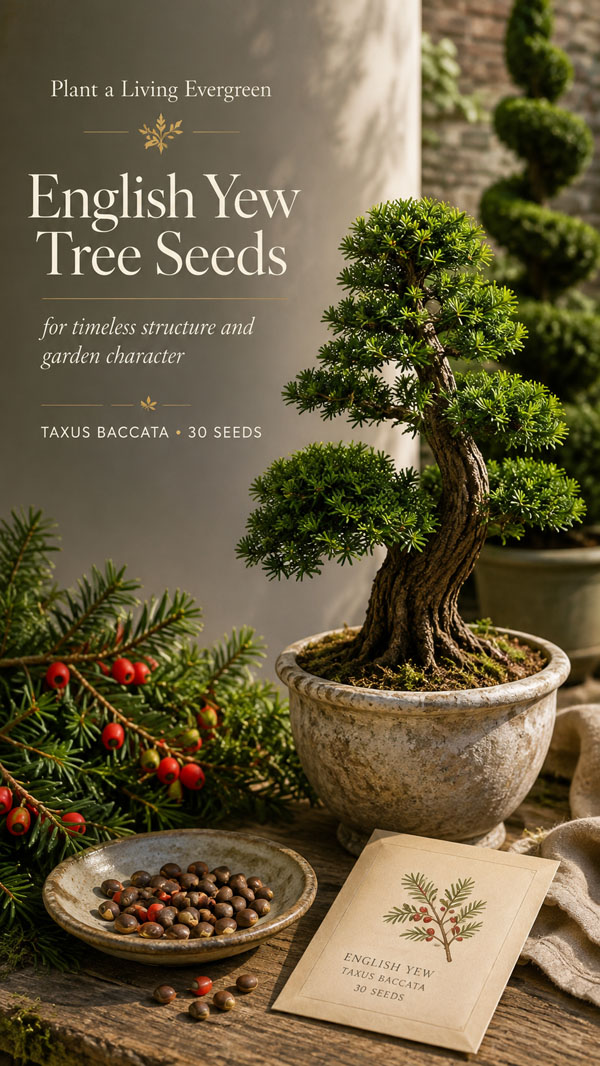
The common or European yew, Taxus baccata, is an evergreen conifer native across much of Europe and into parts of western Asia and North Africa. It has flat, dark green needles and thin reddish-brown bark that flakes with age. Female specimens can bear bright red, berry-like structures called arils, each surrounding a seed.
The fleshy red aril is generally described as the tree's only non-toxic part, but it surrounds a poisonous seed. The needles and most other parts of the tree are poisonous too. The safest approach is to treat all yew material as something to observe rather than taste or gather. That botanical detail matters. The yew's beauty and danger appear side by side, which may partly explain why people have seen it as a guardian of thresholds: it invites attention, but not careless possession.
This article focuses mainly on Taxus baccata because much of the British and Irish folklore surrounding yew belongs to that species and its landscape. The Taxus genus includes other yews found in North America, Asia, and elsewhere, so identify the tree in front of you rather than assuming every yew shares an identical history.
Yew is also valuable to wildlife. Its thick growth gives birds and insects shelter through the year, while birds such as blackbirds and fieldfares can eat the arils and disperse the intact seeds. A tree associated with human graveyards is, from another point of view, a busy winter refuge.
The yew is not a symbol of death because it is lifeless. It became a symbol of death because it shows how much life can remain beside it.

Why the Yew Represents Death and Rebirth
Many plants disappear into winter and return in spring. The yew tells the story differently. Its foliage remains green through the cold months, even while old wood within the trunk decays and disappears.
As a yew ages, its trunk may become hollow. This makes counting growth rings difficult, but it does not necessarily mean the tree is finished. New internal roots may descend through the hollow, and fresh stems can develop as older sections separate. Low branches can also touch the ground and take root, creating another route by which one tree seems to become many.
That is regeneration in a physical, observable sense. The tree does not return to youth. It continues by changing its structure.
This distinction gives yew symbolism unusual emotional honesty. Human renewal is often described as a clean slate, as though becoming new requires erasing what came before. The yew offers another model. Grief may remain part of you. A former life may leave a hollow. An old wound may become a boundary rather than disappear. Still, new roots can form.
The Yew and the Strange Problem of Age
People are understandably fascinated by ancient yews, but exact ages should be treated cautiously. The usual method of counting tree rings becomes unreliable when the oldest heartwood has rotted away. A yew's changing, divided trunk can make circumference-based estimates uncertain too.
This is why the ages claimed for celebrated trees such as the Fortingall Yew in Scotland vary so widely. Some estimates place it at roughly two to three thousand years old, while larger numbers are often repeated. The honest answer is less tidy: it is extraordinarily old, but the tree has outlived the evidence that could give us an exact birthday.
There is something wonderfully appropriate about that. The keeper of mysteries refuses to show us all its rings.

Why Are Yew Trees Found in Churchyards?
Few images are more closely associated with the yew than a broad dark canopy standing among weathered gravestones. Hundreds of English churchyards contain yews older than the church buildings beside them. Other yews were planted much later, so no single explanation accounts for every tree.
Several ideas have been proposed:
- Some churches may have been established at places already important to local communities, where yews were growing before Christian worship began.
- The evergreen tree suited Christian symbolism of resurrection, eternity, and life beyond death.
- Yew foliage was sometimes used in place of palm for Palm Sunday.
- The poisonous tree may have discouraged livestock from wandering into burial ground.
- Churchyards may have offered protected places for useful yew trees, although the familiar claim that they were planted chiefly to supply English longbows does not explain specimens that predate their churches.
It is tempting to choose the most romantic explanation and repeat it as fact. The landscape is more interesting when we resist that temptation. A churchyard yew may belong to several histories at once: pre-Christian place, Christian symbol, village landmark, wildlife shelter, planted memorial, and living elder.
In spiritual practice, the association with burial grounds naturally deepens the yew's connection with ancestors and the dead. Yet it need not make the tree sinister. In a churchyard, the yew often feels less like a herald of death than a steady presence beside it.

Yew in Irish Myth, Sacred Kingship, and Divination
Irish tradition gives us some of the yew's richest surviving stories. Rather than reducing them to the vague claim that “the Celts believed” one thing, it is better to notice the particular texts and traditions that carried the tree forward.
Éo Rossa and the Five Sacred Trees of Ireland
Medieval Irish literature remembers Éo Rossa, the Yew of Ross, as one of the five great sacred trees of Ireland. These extraordinary trees were connected with the ordering of the land, sovereignty, abundance, and the identity of a people. In later poetry, Ireland itself could be praised as a land clothed in yew.
The yew also belonged among the highly valued trees protected under early Irish law. Felling an important tree was not merely a practical loss. A great tree could be bound to status, territory, hospitality, and the well-being of the community around it.
For a modern Green Witch, this adds another layer to ancestral symbolism. The yew is not only a private link to family dead. It can represent the longer memory of place: the people who named a hill, kept a path open, buried their loved ones nearby, gathered beneath a tree, and then passed responsibility for that ground to others.
Yew Rods in the Search for Étain
In an Irish story concerning the missing Étain, the druid Dallán uses rods of yew inscribed with ogham to divine where she has been taken. The tale gives historical roots to the yew's modern association with divination and hidden knowledge, although it does not prove that every later yew divination practice is ancient.
That difference matters. Folklore can inspire contemporary practice without requiring us to invent an unbroken ritual tradition. The documented story is already marvelous: yew wood, marked language, a question asked into uncertainty, and knowledge sought at the edge of what can be seen.
Yew and the Eihwaz Rune
Yew also appears in the Germanic runic world. The rune commonly called Eihwaz is associated by name with yew, while the Old English rune poem describes ēoh as a rough-barked tree, firmly rooted, and enduring.
Modern rune readers frequently connect Eihwaz with endurance, transformation, defense, initiation, and passage between states. Those are contemporary interpretive correspondences built around the rune's name, form, surviving poem, and the yew's physical character. They should not be presented as a complete ancient definition preserved unchanged through time.
If you work with runes, the relationship can still be meaningful. Yew and Eihwaz both ask for patience with processes that are not yet visible. Their strength is not the flash of a sudden victory. It is the rootedness that remains while a life rearranges itself.

Yew in Modern Green Witchcraft
Modern Green Witchcraft draws on the yew's botany, old stories, churchyard presence, and the meanings practitioners continue to discover through direct relationship with the tree. These correspondences are living spiritual interpretations, not proof that every earlier culture followed one universal system of yew magic.
Protection, Boundaries, and the Dark Evergreen
The yew's protective symbolism may come from several directions at once. Its foliage forms a dense wall. Its branches create deep shade. Its toxicity establishes a very real boundary. Its wood was historically prized for bows, joining the tree with defense and warfare as well as sacred use.
In modern magical correspondence, yew may be used as a symbol for:
- protecting the quiet parts of life that are still developing
- maintaining a boundary during grief or major change
- ending an unhealthy pattern without denying what it taught you
- honoring the dead without becoming unable to live among the living
- recognizing that secrecy and privacy are not the same thing
Yew protection is not cheerful, sparkling armor. It is more like the dark shelter beneath an evergreen canopy: quiet, contained, and difficult to hurry.
Ancestral Connection Beyond an Idealized Past
A yew may stand in one place while human names, languages, buildings, and borders change around it. That scale of time makes ancestral association almost inevitable.
Some practitioners understand the yew as a guardian near the veil and work with it when remembering the dead. Others experience the tree symbolically, as a way to hold family history without pretending every inheritance was gentle or wise. Both approaches can make room for a complicated truth: ancestry includes love, survival, rupture, silence, and choices we do not have to repeat.
The yew is especially fitting when ancestral work feels incomplete. You may not know every name. You may be separated from family, culture, or homeland. Your lineage may contain harm alongside belonging. A hollow tree does not require an unbroken record before it can keep growing.
Ancestral connection can also extend beyond blood. Teachers, chosen family, former caretakers of a place, and the more-than-human lives that made your own possible may all belong within a practice of remembrance.

What the Yew Can Mean During Grief and Change
People often reach for rebirth symbolism when they want pain to be over. The yew is less hurried. It does not turn grief into a motivational slogan or insist that every loss happened to make us stronger.
Instead, it offers three quieter possibilities.
You Can Continue Without Becoming Who You Were Before
An old yew does not repair itself by recreating its first trunk exactly. It grows around absence, sends down another root, or lets a branch establish a new point of contact with the earth. Continuation may change your shape.
A Hollow Is Not the Same as Emptiness
A hollow trunk can shelter insects, birds, small mammals, fungi, and the slow work of decay. What looks empty may be inhabited by a different kind of life. Human hollows can be like that too. A place left by loss may eventually hold memory, tenderness, anger, art, service, or simply a greater capacity to sit beside another person's sorrow.
Not Every Transformation Needs to Be Visible
The culture around us loves dramatic before-and-after stories. Yew growth is often slow enough to escape notice. If you are in a season when nothing seems to be changing, that does not mean nothing is happening.
Some beginnings arrive as blossoms. Others begin as a root descending through the dark.

How to Notice Yew Through the Seasons
The yew is evergreen, but evergreen does not mean unchanging. Visiting the same tree at different times of year reveals a quieter seasonal rhythm.
Spring
Look for fresh, lighter green growth against the mature needles. On male trees, small pollen cones release clouds of pollen when disturbed by wind. Spring yew energy can feel less like a dramatic beginning and more like a subtle return of movement.
Summer
The canopy becomes a place of dense shade and coolness. Birds may nest within the protected branches. In a spiritual sense, summer yew can speak to privacy, refuge, and the value of tending what is not ready for display.
Autumn
Red arils become conspicuous on female trees, drawing birds into the foliage. Their brightness is beautiful, but it is also a good time to remember the tree's toxicity. Admiration does not require tasting, gathering, or bringing anything home.
Winter
When deciduous trees are bare, the yew holds its color and structure. Its old trunk may become more visible in the thinner landscape. Winter reveals why people came to associate this tree with endurance, death, and life that persists beyond appearances.

A Safe Green Witch Way to Connect With Yew
Important yew safety: Nearly the whole tree is poisonous. Do not eat it, brew it, burn it as incense, place it beneath a pillow, or leave loose plant material where children, pets, or livestock could reach it. Fallen or dried material has not become safe.
You also do not need to strip bark, break a twig, collect needles, cut symbols into the trunk, or leave offerings at its roots. An old yew may be protected, and even an ordinary garden specimen is a living habitat rather than a supply cabinet.
Try a practice of attention instead:
- Find a yew you may visit respectfully. Remain on permitted paths and observe any rules protecting a churchyard, garden, cemetery, or historic site.
- Look before interpreting. Notice the bark, shape, light, surrounding plants, birds, weather, and signs of old and new growth.
- Choose one detail. It might be a hollow, a newly rooted branch, a red aril, or the way sound changes beneath the canopy.
- Ask what that detail touches in you. Where are you preserving a necessary boundary? What is continuing in a changed form? What deserves remembrance without being carried forever?
- Leave the tree as you found it. Take a photograph, make a sketch, or write a few sentences. Attention can be the offering.
This kind of relationship—attention without extraction—also belongs at the heart of sustainable Green Witchcraft. The tree does not need to lose a branch for the encounter to matter.
If you want a more structured spiritual practice, continue with the safe Sacred Yew Ritual Guide. Its rituals use a living tree, an image, or a drawn symbol rather than harvested yew material.

Yew in a Garden: Beauty With a Serious Boundary
Yew is widely grown as a hedge, topiary plant, and specimen tree because it tolerates pruning, shade, and many soil conditions. Its dense form provides year-round structure and wildlife shelter. It is also slow-growing and potentially very long-lived, so planting one is a decision made partly for people who may garden after you.
Its toxicity must guide placement. A yew may be unsuitable where young children, pets, horses, or other livestock could chew or ingest it. Clippings remain dangerous and should never be left where animals can reach them. Before planting, identify the exact species or cultivar, consider its mature size, and seek local horticultural guidance appropriate to your household and climate.
Spiritually, that practical caution is not separate from the magic. Good boundaries are part of tending life.
Yew Compared With Other Sacred Trees
Sacred trees become easier to understand when we notice how differently they express strength and change.
- Birch carries the bright courage of beginning. It asks what is ready to emerge.
- Willow bends toward water and emotional movement. It asks what needs to be felt, released, or allowed to flow.
- Oak expresses shelter, solidity, and visible strength. It asks what deserves protection and patient building.
- Yew stands where ending and endurance meet. It asks what can continue without remaining unchanged.
No tree is spiritually superior to another. The useful question is which kind of wisdom meets the life you are living now.

Questions to Ask Beneath a Yew
If you visit a yew or sit with an image of one, choose only the question that catches at your attention:
- What ending have I acknowledged with my mind but not yet with my heart?
- What is still alive beneath a part of my life that appears finished?
- Where do I need privacy while something new takes root?
- Which family story deserves to be remembered, and which pattern should end with me?
- Am I waiting to feel like my former self when life is asking me to grow in another shape?
- What boundary protects life rather than closing it away?
- What am I trying to understand before I have allowed myself simply to observe?
For a broader tree-centered practice, you might also explore how to meditate with a living tree without collecting anything from it.
Yew Tree Spiritual Meaning FAQ
Is the yew a symbol of death?
Yes, the yew has a long association with death, burial places, the Otherworld, and remembrance. It is not only a death symbol, however. Its evergreen foliage, longevity, and unusual ability to regenerate also connect it with resurrection, continuity, and life beyond an ending.
What does the yew tree mean spiritually?
Spiritually, yew commonly represents death and rebirth, ancestral memory, endurance, protection, boundaries, transformation, and mystery. Some practitioners understand it as a guardian at the threshold between worlds. Others use its life cycle as a symbol for grief, aging, and renewal through changed forms.
Why is yew associated with ancestors?
Ancient yews can outlive many human generations and are often found in churchyards and other places of burial or communal memory. That presence has helped connect the tree with ancestors, remembrance, and the continuity of a community through time.
Is yew a Celtic sacred tree?
Yew appears in medieval Irish literature, law, place names, and stories involving sacred trees, kingship, and divination. It is reasonable to discuss strong Irish and wider Celtic associations, but broad claims about exactly what “all Celts” or Druids believed should be treated cautiously because the cultures, periods, and surviving sources are not all the same.
What is the connection between yew and Eihwaz?
Eihwaz is the modern conventional name for a rune whose reconstructed name is connected with yew; the related Old English rune ēoh also names the tree. Contemporary rune practice often associates it with endurance, defense, and transformation, although many detailed meanings are modern interpretations rather than a surviving ancient instruction manual.
Is yew associated with Samhain?
Yew's connections with death, ancestors, remembrance, and thresholds make it a natural symbol for some modern Pagan and Green Witch Samhain practices. That does not mean yew material needs to be placed on an altar. A photograph, drawing, or respectful visit to a living tree can carry the symbolism safely.
Can I use yew needles, wood, or berries in magic?
The safest answer is no. Nearly all parts of yew are poisonous, including the seeds inside the red arils. Do not ingest, brew, burn, or keep loose yew material in ritual spaces. Work with a photograph, drawing, written name, or respectfully visit a living tree instead.
What does it mean if I keep noticing yew trees?
There is no universal message that applies to every sighting. In a spiritual practice, repeated encounters might draw your attention to boundaries, remembrance, endings, endurance, or hidden renewal. They may also mean yew grows abundantly along your route. Notice both the symbolic possibility and the ordinary ecology before deciding what the encounter means to you.

The Wisdom at the Threshold
The yew does not offer the innocence of a fresh beginning. Its wisdom belongs to beginnings that carry memory.
It stands green beside gravestones. Birds find winter shelter among poisonous needles. New roots travel through the hollow left by old wood. None of those truths cancels another.
If you are living through a season that cannot be neatly divided into loss or renewal, the yew may feel like an honest companion. Stand at a respectful distance. Notice what is ending, what remains, and what is quietly changing shape. You do not have to solve the mystery to be held by it.