Sacred Yew Ritual Guide: 5 Safe Practices for Grief and Renewal
A yew does not look away from endings. Even in winter, its branches remain dark green. Its old trunk may become hollow while living tissue continues to grow around the opening. From what appears empty, the tree keeps making life.
That is part of what makes yew such a meaningful companion when you are standing between what was and what comes next. Perhaps you are grieving someone. Perhaps an old version of your life has ended, but the new one has not quite begun. Perhaps you simply feel the need to sit beside something that does not rush you to turn loss into a lesson.
This sacred yew ritual guide offers five grounded practices for ancestral connection, remembrance, shadow work, new moon renewal, and dream reflection. They are written for Green Witches and Wiccans who experience yew as a spiritual presence, while leaving room for anyone who approaches ritual as symbolism, focused attention, or a way to give difficult feelings a shape.
You do not need to own a yew tree, gather its branches, or receive a dramatic message. A living tree observed from a respectful distance, a photograph, or a simple drawing is enough.
Before You Begin: Yew Is Poisonous
Yew is a plant to admire, not an herb to consume. Its needles, bark, wood, and seeds contain dangerous toxins. The red flesh around the seed is the exception, but the seed inside it is poisonous, so this guide does not recommend handling or using any part of the tree.
Do not eat yew, brew it as tea, burn it as incense, place it beneath a pillow, or leave cuttings where children, pets, or livestock might reach them. The Royal Horticultural Society’s yew guide recommends gloves when handling clippings, cuttings, or seeds. If ingestion may have occurred, seek urgent medical or poison-control advice.
Every ritual below uses a yew image, a view of a living tree, or a drawn symbol. Nothing needs to be taken from the tree for the practice to be real.
Why Yew Belongs to Life’s Thresholds
Yew has long been associated with churchyards, funerary customs, endurance, death, and immortality. Those associations did not appear from nowhere. They grew around a tree with a genuinely unusual way of aging.
As an old yew hollows, new internal roots may descend through the open trunk and form fresh living structure. The missing center also makes ancient yews notoriously difficult to date: the very evidence people normally count may have disappeared. A yew can therefore look wounded, empty, and enduring all at once.
For a Green Witch, this creates a richer symbol than the cheerful promise that every ending is secretly a beginning. Some endings hurt. Some leave an absence that remains an absence. Yew offers a quieter image: life can continue around what is missing. The hollow does not have to close before growth resumes.
The yew does not ask you to call the hollow whole. It shows you that the hollow and the living tree can exist together.
If you would like to explore the tree’s history, churchyard associations, folklore, and magical correspondences in greater depth, visit the companion guide to yew symbolism and sacred-tree lore. Here, we will stay with practice.

Choose the Ritual That Meets You Where You Are
You do not need to perform all five rituals. Begin with the feeling that brought you here.
- You miss someone or want to acknowledge those who came before you: choose the ancestral listening ritual.
- Your grief needs a place to rest for a little while: choose the remembrance ritual.
- You are avoiding a truth or repeating a painful pattern: choose the shadow work ritual.
- Something has ended and you are ready for one small next step: choose the new moon ritual.
- Your dreams or inner life feel unusually active: choose the dream-threshold practice.
Ritual is not a test of concentration, psychic ability, or spiritual worth. You may feel a presence, remember a forgotten detail, cry, become calm, grow restless, or notice nothing unusual. The practice can still have value. Sometimes the most honest result is simply recognizing what you are carrying.

How to Prepare a Safe Yew Ritual Space
If you have access to a yew in a public garden, churchyard, cemetery, or private landscape, first make sure visitors are welcome. Remain on established paths, observe any posted rules, and choose a place where you will not interrupt mourners, worshippers, gardeners, or wildlife.
There is no need to sit against the trunk or beneath low branches. A bench or quiet place within sight of the tree is enough. If you cannot confidently identify a yew, let the plant remain a beautiful unknown and work later with a verified photograph.
Before giving the tree a spiritual meaning, spend one minute simply looking. Notice the density of the foliage, the flat dark-green needles, the reddish-brown bark, and any bright arils held against the green. Notice where light enters and where the branches keep their shade. Observation lets the relationship begin with the living tree rather than with a list of correspondences.
For an indoor ritual, place a printed yew image, a sketch, or the word Yew on your altar. Add only what supports your attention:
- a candle or battery-operated candle
- a bowl of clean water
- a stone from your own garden or collection
- a journal and pen
- a photograph or heirloom, if the ritual involves remembrance
The empty space matters too. Yew practice is well suited to a simple altar with room at its center. If you enjoy working with elemental symbolism, Earth may be represented by the stone, Water by the bowl, Fire by the candle, Air by your breath, and Spirit by the open center. The site’s guide to the Spirit element in Green Witch practice offers a fuller exploration of that fifth presence.

1. Sacred Yew Ritual for Ancestral Listening
Best for: remembering ancestors, seeking perspective, or feeling your place within a longer story
When to practice: Samhain, the dark moon, a family anniversary, or any quiet evening
“Ancestor” does not have to mean every person in your bloodline, and ancestral practice does not require you to romanticize people who caused harm. You may choose one beloved relative, a chosen-family elder, an unknown but well-intentioned ancestor, the people who protected a tradition you value, or the generations who tended the land where you live.
You Will Need
- a yew photograph or a safe view of a living tree
- a white, black, or deep purple candle
- a bowl of water
- an optional photograph, name, recipe, tool, or family object
- a journal
The Ritual
Place the bowl between you and the yew image. Set the candle beside it and, if you are using a family object, place that nearby. Light the candle safely.
Look at the tree’s dark foliage, branching form, or hollow trunk. Take three unhurried breaths. Then establish the boundary of the ritual aloud:
I welcome only those ancestors and benevolent guides who come in wisdom, honesty, and care. All others must remain outside this space.
Say the name of the person or lineage you wish to remember, if you have one. Ask a question that invites perspective rather than prediction:
- What strength has reached me through those who came before?
- What pattern is mine to continue?
- What pattern may end with me?
- What ordinary act of care would honor my people now?
Sit quietly for five minutes. Notice memories, bodily sensations, words, or images without straining to turn them into a message. If nothing arrives, write what you wish a wise and loving elder could tell you. That answer may reveal the kind of guidance you need.
To close, touch the bowl—not the tree—and say, “The listening is complete. I keep what is helpful and release what is not.” Extinguish the candle and pour the water into a houseplant or your garden at home.
For practitioners who experience the ancestors as a genuine spiritual presence, this listening may become communion. For others, the same silence may open memory, intuition, family history, or a clearer sense of what has been inherited. Neither understanding needs to cancel the other. The ritual asks for respectful attention, not agreement about where the answer came from.

2. Yew Remembrance Ritual for Grief
Best for: a death anniversary, seasonal grief, or the sudden ache of missing someone
When to practice: whenever grief asks to be noticed
Grief does not keep a tidy calendar. It may return in the grocery store, while watering a plant, or when a certain kind of evening light falls across the kitchen. This ritual gives remembrance a beginning and an ending, even when grief itself has neither.
You Will Need
- a candle or small lamp
- a yew image
- a smooth stone that belongs to you
- paper and a pen
The Ritual
Write the person’s name at the top of the page. Beneath it, complete one or more of these sentences:
- I still remember...
- I wish I could tell you...
- You changed my life by...
- Today, your absence feels like...
There is no need to make the memory beautiful. You are allowed to remember an annoying habit, an unfinished conversation, or the way they took their tea. Ordinary details often carry more love than grand statements do.
Place the stone on the paper and light the candle. Look toward the yew image and say:
What has ended is not erased. What was loved has shaped the living. For this moment, I make room to remember.
Read your words aloud or silently. Then sit for as long as feels kind—not as long as you think a “proper” ritual should last. When you are ready, fold the paper and keep it in a memory box, journal, or other private place. Carry the stone for a day if you want a small physical reminder of steadiness.
If grief feels too raw for words, skip the writing. Light the candle, speak the person’s name, and stop there. A brief ritual is not a lesser one.
3. Yew Shadow Work at the Hollow
Best for: facing a truth, recognizing a repeated pattern, or meeting a part of yourself you have pushed aside
When to practice: during the waning moon, in late autumn, or when avoidance is costing more than honesty
Shadow work is sometimes described as a dramatic descent into darkness. Often it is quieter and less glamorous: admitting that you are resentful, lonely, jealous, exhausted, afraid, or still waiting for an apology that may never come.
The hollow yew offers an especially compassionate image for this work. An opening is not necessarily a failure in the tree. It may be part of the form the tree has taken while continuing to live.
You Will Need
- a yew image, preferably one showing an old or hollow trunk
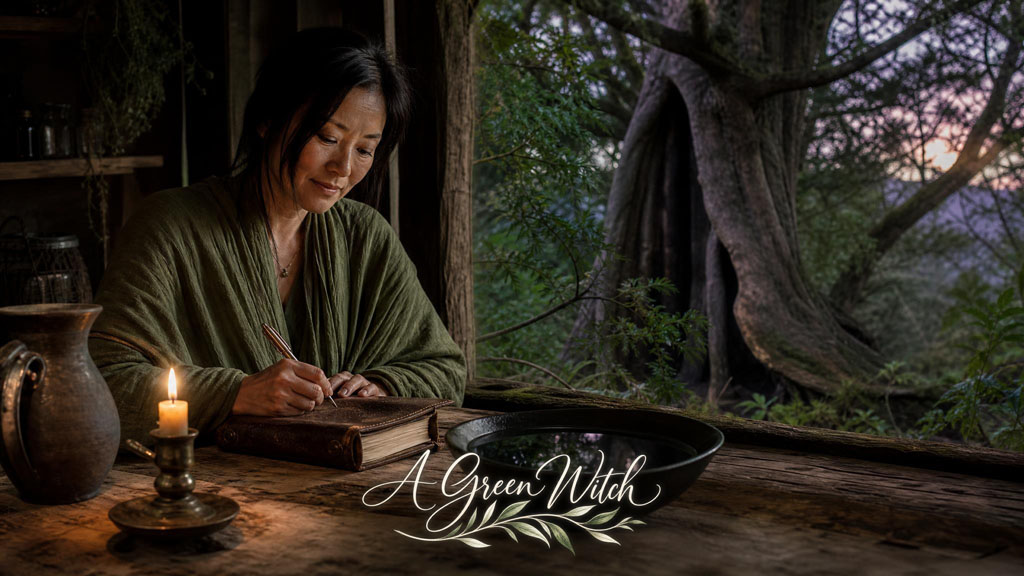
- a dark bowl filled with water
- a candle placed where it cannot reflect too brightly into your eyes
- a journal
The Ritual
Place the bowl before the yew image and let the water become still. You may look into the water, at the tree, or simply at your hands. A mirror is not required; for some people, it makes the exercise more intense than useful.
Choose one question:
- What feeling have I been trying to make more acceptable before I acknowledge it?
- Where am I saying yes while quietly living a no?
- What do I keep calling confusion because I dislike the answer?
- What part of me needs a boundary rather than a punishment?
Write for ten minutes without trying to sound wise. Then draw a circle around one sentence that feels honest and usable. Not the cruelest sentence. Not the most dramatic. Choose the one that suggests a small act of care, repair, truth, or protection.
Close by disturbing the water with one fingertip and watching the reflection change. Say, “I can see this without becoming only this.” Pour the water away and do something ordinary: wash the cup, open a window, or make a snack. Coming back to the room is part of the ritual.
A gentle boundary: Shadow work should not become emotional self-punishment. If the exercise brings overwhelming distress, stop, orient yourself to the room, and reach out to someone you trust or a qualified mental health professional. Ritual may support reflection, but it does not have to hold everything alone.

4. New Moon Yew Ritual for Release and Renewal
Best for: closing a chapter and choosing one modest beginning
When to practice: at the new moon or at any personal threshold
The original temptation in a release ritual is to name everything you want gone. The result can become a rather exhausting inventory of your perceived flaws. Yew suggests a different question: what remains alive enough to tend?
You Will Need
- a yew photograph or drawing
- two small pieces of paper
- a pen
- a candle or battery-operated candle
- a length of ordinary cotton thread
The Ritual
On the first paper, write one thing that has ended or one pattern you are ready to loosen. Keep it specific: “checking for their message every morning” is more workable than “the past.”
On the second paper, write one small act that belongs to the life still growing. It might be “walk before work on Tuesday,” “call the friend who steadies me,” or “clear one shelf for the project I keep postponing.”
Lay both papers before the yew image. Loop the thread loosely around them and say:
I honor what has ended without building my home inside it. I give my care to what is still capable of growing.
Untie the thread. Tear up the first paper and recycle or compost it at home if the paper and ink are suitable. Keep the second paper where you will see it tomorrow. The ritual is completed not by the tearing, but by doing the small act you named.
If you want to build this into a fuller lunar practice, the guide to new moon rituals for different intentions can help you adapt the ceremony without turning the moon phase into a deadline. Missing the exact night does not mean you missed the meaning.

5. Dreaming at the Yew Threshold
Best for: recurring dreams, inner questions, and listening to the imagination
When to practice: before sleep for three consecutive nights
Yew is often linked in modern magical practice with mystery, the Otherworld, ancestors, and hidden knowledge. A dream ritual can honor those associations without treating every dream as prophecy—or placing poisonous leaves anywhere near your bed.
You Will Need
- a yew image placed on a bedside table, not in the bed
- a notebook and pen
- an optional piece of amethyst, smoky quartz, or another familiar non-toxic symbol
The Practice
Before sleep, look at the yew image and choose one question:
- What feeling keeps asking for my attention?
- What am I not yet ready to name?
- What deserves patience rather than an immediate answer?
Write the question at the top of a blank page. Then say:
Keeper at the threshold, let me meet the night with curiosity and return with only what serves my well-being.
In the morning, write down anything you remember before reaching for your phone. A color, place, mood, or single odd detail counts. After three nights, look for repetition. Do not force a prediction. Ask instead, “What does this image help me notice about my waking life?”
If you remember nothing, record the feeling you woke with. Dream practice often begins by strengthening attention, not by producing spectacular dreams on command.

When a Yew Ritual Feels Quiet—or Empty
You may finish a ritual and wonder if anything happened. The candle burned. The water stayed water. No ancestor whispered. No hidden truth arrived wearing a convenient label.
That does not mean you performed it incorrectly.
Spiritual presence is not always dramatic, and symbolism does not have to produce an immediate insight. Sometimes ritual works more like placing a garden marker beside a newly sown seed. You are not claiming that growth has already happened. You are remembering where to return with your attention.
Wait a day or two and notice whether a memory resurfaces, a boundary becomes clearer, or the next small action feels easier to name. Also allow for the possibility that nothing changes. A practice can be sincere without becoming a revelation.
If sitting near trees is the part that helps you most, rather than the ceremonial elements, explore this simple approach to tree meditation and attentive listening. The relationship can begin with observation.

Working With a Living Yew Without Taking From It
A tree does not become more sacred because we remove a piece of it. With yew, restraint is both an ethical practice and a safety practice.
- Do not strip bark, break twigs, collect needles, pick arils, carve symbols, or gather roots.
- Do not burn yew wood or foliage, indoors or outdoors.
- Do not leave candles, crystals, ribbons, coins, food, salt, wax, or paper at the tree.
- Do not pour oils, alcohol, milk, or herbal mixtures onto its roots.
- Keep children and animals away from fallen material and hedge clippings.
- Follow the rules of cemeteries, churchyards, public gardens, and protected sites.
A fitting offering might be an action performed elsewhere: pick up litter along the path, support the garden that protects the tree, learn the names of nearby species, or tend your own patch of soil without chemicals that harm wildlife. This is the heart of a more reciprocal Green Witch practice: devotion expressed as care, not collection.

Sacred Yew Ritual FAQ
Do I Need a Real Yew Tree for These Rituals?
No. A photograph, botanical illustration, or hand-drawn yew symbol can hold your focus. If yew does not grow where you live, using an image is more respectful than buying plant material of uncertain origin. Distance does not make the symbolism meaningless.
What Does Yew Represent in Green Witchcraft?
Yew is commonly associated with longevity, death, remembrance, protection, transformation, ancestors, and renewal. Different traditions and individual practitioners may understand those correspondences differently. Its physical persistence—evergreen foliage, great age, hollowing, and renewed internal growth—offers a grounded foundation for the symbolism.
Is It Safe to Touch Yew or Keep It on an Altar?
Brief skin contact is not the same as swallowing the plant, but yew is not suitable for casual ritual handling. The Royal Horticultural Society advises wearing gloves when working with clippings, cuttings, or seeds. This guide recommends using an image instead of actual yew, which prevents accidental mixing with herbs and removes the risk of a child or animal finding the material. Never burn or ingest yew.
What Is the Best Time for a Sacred Yew Ritual?
Samhain, the dark moon, the new moon, late autumn, funerary anniversaries, and personal turning points all suit yew symbolism. None is required. The best time is when you can be present and when the practice meets a genuine need.
Can I Practice a Yew Ritual If I Am Not Wiccan?
Yes. These rituals use language familiar to Green Witch and Wiccan practice, but they do not require a particular religion, deity, or supernatural belief. You may approach yew as a plant spirit, a sacred ally, a cultural symbol, or a living tree whose biology gives you a new way to think about change.
What If Ancestor Work Does Not Feel Safe?
Do not force it. You can honor a chosen elder, a writer or teacher whose work shaped you, future generations, or the living land instead. You can also choose the renewal or observation practice and leave ancestry out entirely. A ritual should not require you to grant access to people you worked hard to escape.

A Small Daily Yew Practice
On difficult mornings, look at a yew image and place one hand over your heart or on the table in front of you. Ask:
What is gone? What remains? What is one living thing I can tend today?
Your answer does not need to be poetic. It may be “the basil needs water,” “I need breakfast,” or “I should answer that email.” The yew is an ancient symbol, but the next act of renewal is often stubbornly ordinary.
The Tree That Does Not Hurry You
Yew holds an unusual tension: evergreen and funerary, poisonous and sheltering, hollow and alive. It does not flatten death into a pleasant metaphor, nor does it suggest that renewal means returning to who you were before.
That may be why this tree speaks so clearly during the in-between seasons of a life. It lets grief remain grief. It lets mystery remain unanswered. It asks only that you notice what is still living around the hollow and decide, gently, what you are willing to tend.
The next time you pass a yew—or even a photograph of one—pause for a breath. You do not need to take a branch, leave a gift, or ask for a sign. Notice the dark green growth. Notice the space within it. Then carry one small act of care back into the world.