Willow Tree Spiritual Meaning: The Enchantress of Water, Moon & Mystery
There is something about a Willow that changes the feeling of a place.
Its branches do not simply reach toward the sky. They fall like green curtains toward the Earth, moving with the smallest breeze and creating a hidden room beneath the leaves. Near a pond or river, those branches may nearly touch their own reflection, as though the tree belongs partly to the land and partly to the mysterious world beneath the water.
When the wind turns the narrow leaves, flashes of silvery green ripple through the canopy. Beneath an old weeping Willow, even familiar sounds seem softened.
Perhaps that is why the Willow tree spiritual meaning has become so deeply connected with intuition, emotion, healing, grief, resilience, dreams, lunar magic, and the element of Water.
For a Green Witch, Willow is more than a collection of magical correspondences. It is a living teacher.
Willow demonstrates that softness is not weakness. It flourishes where Earth and Water meet, survives changing seasons, and responds to wind with movement rather than rigidity.
To spend time with Willow is to enter a quieter kind of magic, one that asks us to listen before acting, feel without becoming lost in feeling, and recognize that change does not always require force.
The Willow does not conquer the river. It grows beside it, bends above it, and learns the language of change.
What Does the Willow Tree Symbolize?
Across folklore, poetry, magical traditions, and modern nature spirituality, Willow has gathered many meanings.
Some are beautiful. Some are melancholy. Some are wonderfully strange.
Willow has been associated with Water, the Moon, intuition, grief, love, poetry, protection, flexibility, dreams, healing, feminine energy, and emotional renewal.
These meanings did not all emerge from one culture or one ancient spiritual system. Willow symbolism developed over centuries as people observed the tree itself and wove those observations into stories.
That distinction matters.
Green Witchcraft becomes more meaningful when we allow folklore to remain folklore, historical traditions to remain historical, and our personal spiritual relationships with plants to grow alongside them rather than pretending every modern correspondence belongs to one unbroken ancient tradition.
- Water: emotion, intuition, reflection, healing, and flow
- Moon: cycles, dreams, receptivity, and inner awareness
- Grief: mourning, remembrance, release, and emotional processing
- Resilience: flexibility, adaptation, and surviving change
- Creativity: poetry, imagination, music, and inspiration
- Protection: boundaries and protective folklore in several traditions
- Renewal: regrowth, transformation, and beginning again
- Intuition: listening inward and noticing what cannot always be explained logically

Why Willow Is So Deeply Connected to Water
Long before Willow became a magical correspondence for Water, the tree itself was already telling the story.
Many species within the Salix genus naturally favor moist environments. Willows are commonly found near streams, rivers, wetlands, lakeshores, damp woodland, and other places where water remains close to the soil.
That ecological relationship gives the spiritual symbolism an unusually beautiful foundation.
Water in Green Witchcraft is associated with emotion, intuition, dreams, compassion, memory, healing, and the unseen currents moving beneath everyday life. You can explore those correspondences more deeply in my guide to the Water element in Green Witchcraft.
Willow seems almost designed to embody them.
Stand beside a Willow growing over water and notice how many boundaries begin to blur.
Branches meet reflections. Wind becomes movement. Sky appears beneath your feet. Light breaks apart across the surface of the water while the leaves move overhead.
For a spiritual practitioner, that landscape naturally invites reflection.
Where am I resisting something that wants to change?
What emotion have I been avoiding because I fear it will overwhelm me?
What might happen if I listened to what I feel without immediately trying to fix it?
Water reminds us that emotion does not have to remain frozen in one form forever.
The Willow and the Moon
The Willow's relationship with water eventually became intertwined with another powerful spiritual symbol: the Moon.
Traditional Willow folklore includes recurring lunar associations, and its connection with watery landscapes makes the pairing feel especially natural.
Within modern Green Witchcraft, this relationship has grown into a beautiful correspondence between Willow and lunar awareness, dreams, intuition, emotional cycles, and receptive magic.
Picture moonlight reaching through hanging branches and scattering across a dark pond. The scene itself explains much of the symbolism before a single correspondence is written down.
The Moon does not remain visually unchanged from night to night.
Neither do we.
There are times for expanding outward and times for becoming quiet. Times for beginning and times for releasing. Times when clarity arrives brightly and others when we must move through uncertainty without demanding immediate answers.
Willow fits naturally into this lunar rhythm because its symbolism does not require constant growth or perpetual positivity.
It makes room for retreat, grief, mystery, and eventual renewal.
If lunar practice already forms part of your path, you might explore how Willow symbolism complements the Five Elements during the New Moon. Rather than making Willow the centerpiece of every Moon practice, simply noticing its Water-like qualities can add another layer of meaning.

Willow in Mythology and Folklore
One of the most fascinating things about Willow is that its folklore is not uniformly cheerful.
Willow can be protective and ominous, poetic and sorrowful, beautiful and slightly uncanny.
I rather like that.
Nature rarely fits neatly into the tidy boxes humans create for it.
Willow, Hecate, and Greek Tradition
Traditional Willow lore includes an association with Hecate, the Greek goddess connected with crossroads, magic, night, boundaries, and the underworld.
Willow also appears within Greek stories connected with water and poetic inspiration. Over time, these threads contributed to its wider associations with mystery, magic, and the unseen.
For a modern Green Witch, Hecate's Willow connection does not mean you must work with Hecate to honor the tree. It simply adds another strand to Willow's enormous tapestry of symbolism.
You may approach Willow through deity devotion, secular nature spirituality, Wicca, animism, meditation, folklore study, gardening, or simple affection for the tree itself.
The tree requires no spiritual membership card.
Willow as a Tree of Poetry and Inspiration
Willow has also accumulated associations with poets, music, imagination, and inspiration.
This feels especially fitting beneath a mature weeping Willow.
The interior of the canopy can feel almost architectural. Sound changes slightly. The outside world becomes filtered through leaves. Light arrives in fragments, and hundreds of narrow leaves answer the breeze at once.
It creates the kind of place where thoughts behave differently.
For writers, artists, musicians, journalers, and dreamers, Willow symbolism can therefore become less about supernatural inspiration and more about creating the conditions in which imagination is allowed to surface.
Sometimes the Muse simply needed us to stop checking our phone.
The Sadder Side of Willow Folklore
Willow has also become strongly associated with sorrow and mourning.
The Woodland Trust notes that Willow has represented both love and happiness as well as grief, with its melancholy associations appearing repeatedly in English literature and art.
The image of the weeping Willow eventually became closely connected with mourning and appeared frequently in cemetery imagery, memorial art, poetry, and decorative symbolism.
For a Green Witch, this does not make Willow a gloomy tree.
It makes Willow an unusually honest one.
Our relationship with nature does not need to revolve exclusively around abundance, manifestation, sunshine, and things blooming on command.
Gardens contain fallen petals. Forests contain deadwood. Autumn follows summer. Some dreams end.
Willow gives sorrow a place in the landscape without allowing sorrow to become the entire landscape.

Willow Tree Meaning for Grief, Healing, and Letting Go
One reason Willow remains meaningful in modern spiritual practice is its association with emotional healing and release.
I would describe this carefully.
A tree does not erase grief. Sitting beneath a Willow is not a substitute for therapy, medical care, community, or whatever genuine support a difficult season may require.
But nature can give us somewhere to place our attention while emotion moves through us.
There is a difference between asking nature to cure us and allowing nature to accompany us.
Willow is particularly beautiful for the second.
Its branches create privacy without complete isolation. Moving leaves give restless eyes something gentle to follow. Nearby water may add rhythm and sound. Nothing asks you to hurry.
Rather than expecting Willow to take pain away, you might simply sit beneath one and acknowledge:
This is what I am carrying today. I do not need to solve all of it before I am allowed to rest.
Willow symbolism also offers a gentler way to think about letting go.
Release is rarely one clean moment. We may know a chapter is finished and still miss who we were inside it. We may forgive and still remember.
Leaves loosen when their season is finished. Water carries what falls into it onward.
Neither process needs to happen all at once.
If you are moving through grief, heartbreak, transition, or the ending of an old identity, Willow can become a symbol of gradual release rather than forced closure.
That is not flashy magic.
Sometimes it is the kind we need most.

The Spiritual Meaning of Willow and Resilience
Willow's flexibility has made it a natural symbol of resilience.
We sometimes imagine strength as rigidity.
Stand firm. Hold your ground. Never bend.
Willow offers another possibility.
Strength can include movement.
Changing your mind does not always mean abandoning your principles. Resting does not mean surrendering your purpose. Leaving a situation that repeatedly harms you is not the same as failing to endure it. Reconsidering the path can sometimes be wiser than marching stubbornly toward the wrong destination.
Willow symbolism asks a quieter question:
What deserves to remain steady, and where might flexibility serve me better?
When life feels unsettled, consider writing about these questions:
- What am I trying too hard to control?
- Where would flexibility serve me better than resistance?
- What values need to remain steady?
- What emotion needs room rather than suppression?
- What would adapting without abandoning myself look like?
Willow and the Divine Feminine
Modern magical traditions often describe Willow as carrying divine feminine energy because of its associations with Water, the Moon, cycles, intuition, receptivity, and emotion.
I find this symbolism beautiful when we allow it to remain expansive rather than restrictive.
The divine feminine is not limited to women, nor must intuition, tenderness, emotion, receptivity, or nurturing belong exclusively to one gender.
Instead, Willow can represent qualities that many traditions have historically described as feminine: receiving rather than pursuing, listening rather than declaring, gestating rather than producing, and allowing wisdom to emerge slowly.
Our culture often rewards Fire.
Move. Build. Achieve. Push. Perform.
Willow reminds us that Water also has power.
Water shapes stone without shouting at it.
There are seasons when action is sacred and seasons when listening is.

Willow Through the Five Elements
Although Willow is most strongly associated with Water, one of my favorite ways to understand a plant spiritually is through all Five Elements: Earth, Water, Fire, Air, and Spirit.
Doing this prevents a tree from becoming a one-word correspondence in a magical encyclopedia.
A living Willow contains far more than “Water = intuition.”
Earth: The Roots That Hold
Earth appears in Willow's roots, soil, physical body, habitat, and connection with the land beneath wet places.
This is Willow's grounding lesson.
Emotional sensitivity without grounding can become exhaustion. Intuition without discernment can become confusion. Spiritual exploration without an ordinary life beneath it can become untethered.
Earth reminds us to eat, sleep, garden, walk, work, care for our bodies, and live here.
Willow may lean over mysterious water, but it still grows from soil.
Water: The Current Beneath the Surface
Water is Willow's most obvious elemental companion.
Here we find emotion, compassion, grief, memory, dreams, adaptability, and intuition.
Water asks us to experience what we feel without allowing every feeling to define us.
Fire: The Courage to Transform
Willow is not usually considered a strongly fiery tree, which makes Fire especially interesting to contemplate.
Fire represents will, courage, transformation, desire, and action.
Sometimes reflection reaches a point where something must change.
A boundary must be spoken.
A decision must be made.
A new beginning must be chosen.
Willow's Fire may be the small inner flame that finally says, I am ready.
Air: The Whispering Leaves
Anyone who has stood beneath a Willow on a breezy day has encountered its relationship with Air.
The leaves respond to movements we cannot see.
Air represents thought, communication, perspective, breath, and inspiration.
This element brings discernment to Willow's emotional symbolism.
What am I actually feeling?
What story am I telling myself about what I feel?
Are those two things the same?
Air creates space around emotion so we can examine it with tenderness and clarity.
Spirit: The Tree as a Whole
Spirit is not another ingredient placed beside the other four.
It is relationship.
Spirit is what happens when root, water, movement, light, season, animal, human attention, decay, regrowth, memory, and mystery become one living whole.
For a Green Witch, this may be where Willow becomes sacred.
Not because a correspondence chart declared it so, but because sustained attention reveals that the tree participates in a world much larger than our individual lives.
If you enjoy working with plants in this relational way, my guide to building intuitive relationships with plant spirits explores this approach more deeply.

Building a Relationship With Willow in Green Witchcraft
So what does working with Willow actually mean for a Green Witch?
It does not require harvesting bark, performing elaborate spells, or owning a Willow tree.
In fact, the simplest practice may be the most important.
Learn the tree.
Find a Willow you can visit regularly if one grows somewhere accessible to you.
Learn its species if you can. Notice where it lives. Watch when the first leaves appear. See which birds move through the branches and which insects visit during the warmer months.
Return in different weather.
Notice the hush beneath the canopy after rain, the silver-green flicker of leaves before a storm, the sparse architecture of the branches in winter, and the softness that returns with spring.
Then notice what happens within you when you spend time there.
Do not rush to label every sensation as energy, communication, or a sign.
Allow familiarity to develop.
There is a beautiful intimacy in knowing a particular tree through February rain, May green, August heat, and November leaves.
Eventually, Willow stops being an abstract “magical property.”
It becomes that Willow.
The one beside the pond.
The one where the cardinal nests.
The one whose leaves turn pale when the wind changes.
The one you sat beneath during a difficult year.
This is the heart of Green Witchcraft for me.
Magic becomes richer when enchantment and ecology are allowed to know each other.

Simple Ways to Honor Willow
You do not need a formal spell every time you want to connect with a sacred tree. Small gestures can build relationship without turning every encounter into a ritual.
- Sit beneath a Willow without asking for anything. Observation itself can be devotional.
- Journal near water. Let the landscape invite reflection.
- Photograph the same tree through the seasons. Over time, the images become a visual meditation on change.
- Add a naturally fallen Willow twig to your altar. Gather only where appropriate and avoid damaging living trees.
- Learn about the wildlife the tree supports. Honoring Willow can include honoring the community of life around it.
- Meditate beneath the branches. If tree meditation is new to you, my guide to meditating with trees offers a gentle place to begin.
- Use Willow as a journaling symbol. Ask what needs attention, movement, patience, or release.
Willow, Dreams, and Intuition
Willow's connections with the Moon, Water, poetry, and mystery have naturally made it a favorite symbol for dreamwork and intuition.
I approach this part of Green Witchcraft with curiosity rather than certainty.
A vivid dream does not automatically predict the future.
A thought that appears beneath a Willow is not automatically a message from the universe.
But dreams, imagination, intuition, and symbolism can sometimes reveal what our conscious minds have not yet put into words.
You might place an image of Willow beside your journal, meditate on its branches before sleep, or simply use the tree as a symbol for questions that do not have immediate answers.
Instead of asking, What is Willow predicting?, try asking:
What am I noticing?
That one question keeps spiritual practice wonderfully alive without forcing every breeze into an omen.

Growing Willow in a Green Witch Garden
For some readers, honoring Willow may eventually mean growing one.
Before planting, learn about the particular Willow species you are considering and whether it is appropriate for your property and region.
Salix is an enormous genus containing trees and shrubs with very different sizes, habits, and environmental needs.
Many Willows favor moist soil and plenty of sunlight, but “Willow” is not a single plant with one universal care sheet.
Large species can also develop substantial root systems and should not be planted casually beside foundations, drainage systems, septic systems, pipes, or other infrastructure.
Choose the right Willow for the right place.
A garden becomes more magical when the magic does not eventually require a plumber.
If your property is not suited to a large Willow, you do not need one to build a relationship with the tree.
Visit Willows growing in parks, botanical gardens, wetlands, public landscapes, or wild places where access is permitted.
Green Witchcraft is relationship, not possession.
If you are developing a broader magical landscape at home, you may also enjoy my guide to creating a Green Witch garden that works with nature.
Harvesting Willow With Respect
Willow is famous for its usefulness. Flexible young stems have historically been woven into baskets, fencing, structures, and other objects.
That does not mean every Willow we encounter is ours to harvest.
If you wish to bring Willow into magical practice, begin with the least intrusive option.
Use naturally fallen twigs when they are clean and appropriate. Harvest from living trees only when you have permission and understand how to do so without causing unnecessary damage.
Avoid stripping bark from trunks or large branches simply for ritual use. Bark damage creates wounds in the tree and can interfere with the tissues responsible for transporting water and nutrients.
Ask yourself whether the practice actually requires physical plant material.
Often, it doesn't.
A photograph, drawing, fallen leaf, written symbol, or meditation beside the living tree may carry more meaning than a jar filled with ingredients harvested because a correspondence list said you needed them.
This approach pairs naturally with ethical and sustainable Green Witchcraft, where reverence for nature includes protecting the beings we consider sacred.

A Note About Willow Bark and Herbal Use
Willow bark deserves particular care because it is not merely a symbolic magical herb.
Willow species contain salicylate compounds and have a long history of medicinal use. These compounds are part of the fascinating history that eventually contributed to the development of modern pain-relieving medicines.
But “natural” does not mean pharmacologically inactive.
The National Center for Complementary and Integrative Health notes important concerns involving willow bark, including gastrointestinal effects, sensitivity to salicylates, bleeding risk in some people, pregnancy and breastfeeding considerations, and risks involving children and certain medications.
For that reason, I do not recommend casually preparing Willow bark teas, internal herbal remedies, ritual drinks, or bath preparations simply because Willow appears on a magical correspondence list.
If medicinal Willow interests you, approach it as herbal medicine and speak with a qualified healthcare professional or experienced clinical herbalist who can consider medications, allergies, pregnancy, medical conditions, and appropriate preparation.
A plant can be spiritually meaningful without needing to be consumed.
Sometimes the most respectful way to work with a sacred plant is simply to know it, protect it, sit beside it, and allow it to remain whole.

Creating a Willow-Inspired Altar
If Willow feels meaningful to you but you do not live near one, an altar can become a symbolic meeting place.
You do not need to fill it with purchased magical supplies.
Instead, choose objects that express Willow's qualities:
- A bowl of clean water for emotion and reflection
- A photograph or drawing of a Willow tree
- A naturally fallen twig or leaf, if ethically gathered
- A moonstone or another personally meaningful lunar symbol
- A small mirror representing reflection
- A journal for dreams and intuitive impressions
- A candle representing the quiet Fire of transformation
- A feather or incense for Air and perspective
- A stone or small bowl of soil for Earth and grounding
Together these objects can create a small representation of the Five Elements rather than reducing Willow entirely to Water.
If you are new to natural altars, you can find more ideas in my guide to creating an altar with natural elements.

Willow Compared With Other Sacred Trees
Every sacred tree seems to teach its own dialect of nature's language.
The Birch speaks beautifully of renewal and fresh beginnings.
Birch asks, What is ready to begin?
Willow asks, What is ready to move?
The Yew carries symbolism of longevity, death, transformation, and mystery.
Where Yew can feel ancient and still, Willow feels fluid. One stands at the threshold. The other leans toward the river.
And the Oak embodies strength through solidity and endurance, while Willow suggests strength through responsiveness.
Neither lesson is superior.
Sometimes we need Oak.
Sometimes we need Willow.
Wisdom is knowing which kind of strength the season requires.
Questions to Ask Beneath a Willow Tree
If you enjoy journaling outdoors, Willow offers wonderful themes for reflection.
- What am I being asked to feel rather than solve?
- Where am I resisting a natural change?
- What part of my life needs greater flexibility?
- What deserves greater stability?
- What sorrow needs acknowledgment rather than avoidance?
- What has been quietly healing?
- What does intuition feel like in my body?
- Where am I confusing fear with intuition?
- What am I ready to release gradually?
- What deserves to remain?
- Where could softness become a form of strength?
- What season am I actually in right now?
You do not need to answer them all.
One honest question carried on a quiet walk can be more useful than twenty pages written because you thought you were supposed to be profound.
What Willow Can Teach the Modern Green Witch
The spiritual meaning of Willow feels particularly relevant in a culture that rarely stops moving.
We are encouraged to optimize our mornings, monetize our hobbies, track our sleep, answer messages immediately, turn healing into productivity, and transform every quiet interest into another accomplishment.
Willow offers terrible productivity advice.
Thank goodness.
It asks us to notice water.
Watch light.
Listen to leaves.
Allow emotion.
Change when change is necessary.
Rest without turning rest into another performance metric.
And perhaps most importantly, accept that not every mystery needs to be solved.
Some wisdom arrives as an answer. Some arrives as the ability to remain peacefully beside the unanswered question.

The Willow as Enchantress of the Waters
I still love the old title I gave Willow: the Enchantress of the Waters.
Not because Willow must possess supernatural powers for the name to be meaningful.
Look at the tree.
Its roots find moisture beneath the Earth.
Its branches drift toward water.
Its leaves catch invisible currents of Air.
Sunlight moves between them in flashes of Fire.
And somewhere in the meeting of all those things, Spirit appears.
At dusk, the branches may become little more than a dark curtain against the water while the last light catches their edges. On a moonlit night, the same tree can seem entirely different without having changed at all.
That is enchantment enough.
The Willow tree spiritual meaning ultimately comes back to our relationship with change.
It teaches that grief and beauty may occupy the same landscape. That intuition requires listening. That tenderness and resilience are not opposites. That change does not always have to be fought. That emotional waters can move without carrying away everything we are.
For the Green Witch, Willow does not need to promise prophecy, perfect healing, or mysterious supernatural answers.
Its real magic may be quieter.
It invites us to stand beside the changing water, notice what is moving around us and within us, and remain open enough to keep growing.
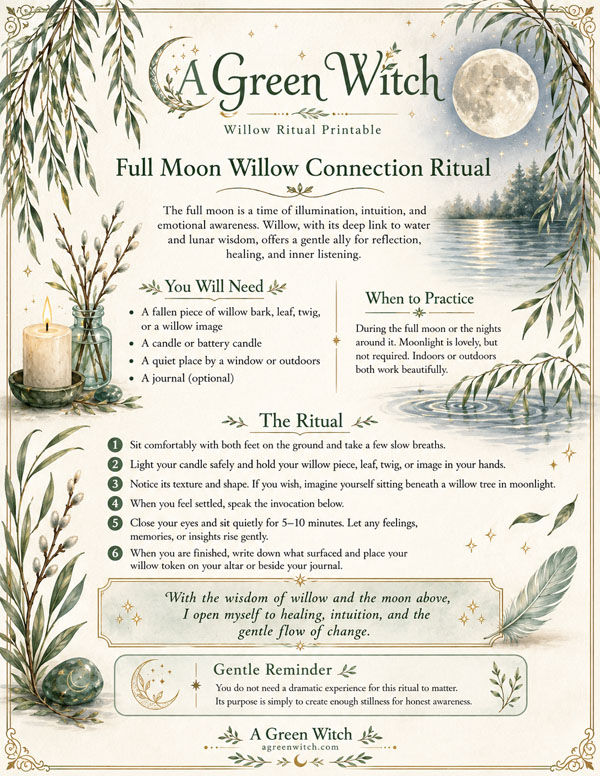
If you feel called to move from Willow symbolism into actual spiritual practice, continue with my dedicated Willow Ritual Guide. There you will find the ritual-focused material intentionally kept separate from this exploration of Willow meaning, folklore, ecology, and symbolism.