Balance in a garden rarely looks like two perfect halves.
One bed needs more water. Another needs less. Tomatoes may still be producing while basil is already giving itself over to seed. The hours of darkness are growing, but autumn does not arrive everywhere at exactly the same pace.
Even the equinox itself is more interesting than the familiar image of twelve perfectly equal hours of daylight and darkness. NASA explains that day and night are not precisely equal on the equinox. The visible disk of the Sun and atmospheric refraction add several minutes of daylight, and the closest day-night split varies by latitude.
I think that makes the spiritual metaphor better, not worse.
Balance is not maintaining equal weight forever. Balance is noticing where adjustment is needed.
This Mabon ritual uses the Five Elements and two small bowls to explore that kind of living balance. You can perform it alone at an altar, outside in the garden, beside an open window, or anywhere you can give the season a little uninterrupted attention.
If you are new to the Sabbat itself, the complete Green Witch guide to Mabon places this ritual within the larger autumn equinox season.
What Are You Trying to Balance?
Before beginning this autumn equinox ritual, choose one tension that is actually present in your life.
Perhaps it is work and rest, tending others and tending yourself, action and reflection, holding and releasing, harvesting and preserving, or speaking and listening.
You are not looking for proof that one side is good and the other is bad. Most living tensions exist because both sides have a purpose.
A garden needs growth and dormancy. We need effort and recovery. Sometimes we need to speak. Sometimes listening is the wiser work.
Write your chosen tension at the top of a piece of paper:
What in my life needs a more useful balance for the season ahead?
This is a seasonal spiritual practice for noticing where your time, attention, care, and energy have been going. It is not meant to diagnose or treat emotional or mental-health concerns.

What You Need for This Solitary Mabon Ritual
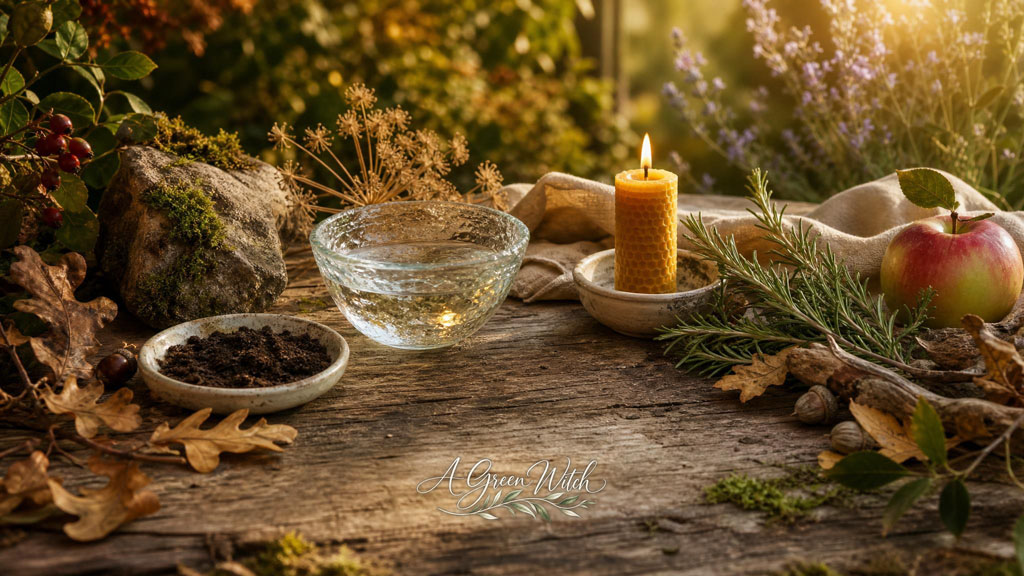
Use what you already have. Nothing here requires a trip to a metaphysical shop.
- One candle
- A small bowl of water
- A stone, small dish of soil, or another Earth object
- A fragrant familiar herb such as rosemary or garden sage
- One harvested fruit, vegetable, nut, or seed
- Two small empty bowls
- A handful of beans, seeds, acorns, pebbles, or other small counters
- Paper and something to write with
- An altar, if you use one
If this is your first Mabon ritual, that simple collection is plenty. You do not need prior ritual experience, special tools, or a formal altar to follow the practice.
If you would like a more permanent ritual space, the guide to creating an altar with natural elements offers an easy starting point.
If you want the altar materials themselves to come from your garden, balcony, or local harvest, choosing Mabon herbs and harvest materials from what is actually growing around you takes that idea further.
Otherwise, a kitchen table will do perfectly well.

Set the Five Elements Around You
The Five Elements are not included simply to give you five objects to arrange.
Each one asks a different question.
Earth asks what supports and sustains you. Place your stone, soil, fruit, or seed where you can touch it.
Water asks what needs movement, softness, or room to change. Set down your bowl of water.
Fire asks what deserves effort and attention. Light your candle safely, or use sunlight if you prefer not to work with flame.
Air asks what needs to be named, understood, spoken, or heard. Place your herb nearby and notice its scent.
Spirit holds relationship, meaning, and the reason you have chosen to stop here at all.
If your practice includes deity, ancestors, land spirits, or plant spirits, you may invite their presence in whatever way feels natural within your path. If you understand the Five Elements more symbolically, they can simply become five different ways of examining the same question.
The Mabon Balance Ritual
1. Arrive Before You Try to Change Anything
Sit or stand comfortably.
Do not begin with the problem.
First notice where you are.
Feel the floor or soil beneath your feet. Notice the temperature of the air. Listen for the nearest sound. Find something green, brown, gold, red, or visibly changing with the season.
Take several ordinary breaths. There is no need to breathe perfectly or force yourself into a particular mood.
When you feel present enough to begin, say aloud or silently:
I meet this season as it is, and I meet myself as I am.
2. Name Your Harvest
Pick up the fruit, vegetable, seed, nut, or other harvest object.
Ask:
What has grown since spring?
Your answer may be tangible. Perhaps you completed something, learned a skill, strengthened a relationship, grew food, or kept a promise to yourself.
Perhaps the harvest is quieter.
Something survived.
Name one thing and set the harvest object beside Earth.

3. Fill the Two Bowls
Place the two empty bowls in front of you.
Let the first represent:
What has received much of me?
Let the second represent:
What has been waiting for me?
Begin distributing your seeds, beans, acorns, or pebbles between the bowls.
You can count if that helps, but the point is not mathematical precision. Let the amounts represent your sense of where your attention has gone.
Maybe nearly everything lands in work.
Maybe much of it has gone toward caregiving.
Maybe you discover that you have rested more than expected because rest was genuinely what the season required.
Look at the bowls before correcting anything.
4. Do Not Make the Bowls Automatically Equal
This is the heart of the Mabon balance ritual.
The obvious temptation is to move the counters until both bowls contain exactly the same amount.
Don't.
Ask instead:
What distribution actually serves the season ahead?
A parent caring for a young child may not have two symmetrical halves available. Someone moving through grief does not need to prove balance by producing as much as they rest. A garden preparing for winter does not devote equal resources to flowering and seed production.
Living systems redistribute.
Move the counters only if something genuinely needs to shift.
Perhaps one stone moves.
Perhaps several do.
Perhaps nothing changes at all, but seeing the current arrangement clearly tells you something you needed to know.

5. Walk the Question Through the Five Elements
Return to the tension you wrote at the beginning.
Touch Earth and ask:
What is actually sustaining me?
Touch or look into Water and ask:
What needs to soften, move, or be allowed to change?
Look toward the candle or sunlight and ask:
What deserves more of my energy?
Rub the familiar herb gently between your fingers, notice its scent, and ask Air:
What needs to be named?
Then stop reaching for objects.
For Spirit, ask:
What connects all of this?
You may experience an answer as intuition, prayer, spiritual guidance, an ordinary realization, or something harder to name.
And sometimes nothing arrives.
Silence is allowed to remain silence.
6. Make One Seasonal Adjustment
Look again at the bowls.
Choose one practical adjustment that reflects what you noticed.
Go to bed thirty minutes earlier one night. Spend an hour outside. Say no once. Make the phone call you have been postponing. Finish one neglected task. Leave one unnecessary task unfinished. Put the phone away during dinner.
The ritual does not need to send you home carrying a fresh bundle of ten intentions.
Choose the one adjustment you are actually willing to try.
Write it down.

7. Close With Gratitude
Thank the Earth, the Elements, deity, spirits, ancestors, your own attention, or whatever feels appropriate within your practice.
Extinguish the candle safely.
Drink the water if it is clean and suitable, or return clean water appropriately. Eat your harvest item later if it is edible. Compost suitable plant material rather than leaving ritual debris outdoors.
Your stones, beans, or other counters can return to wherever they normally belong.
The ritual has done its work. It does not need to remain frozen on the table.

A Five-Minute Mabon Ritual for a Busy Equinox
If the equinox arrives in the middle of work, family obligations, dinner, laundry, and an overflowing calendar, use the bones of the ritual.
Take one natural object and two bowls.
Name one thing receiving much of your energy and one thing that has been waiting.
Place a few seeds or stones in each bowl to represent the current balance.
Then ask:
Does anything actually need to move?
If yes, move one counter and name one small action that would represent the adjustment during the coming week.
Then step outside or stand beside a window. Look at the evening sky, a tree, the garden, or the nearest plant.
The season has been changing whether or not you had time to arrange a formal ceremony.
If short rituals fit your life better, these small daily Green Witch practices can help keep nature-centered spirituality from becoming another item on the to-do list.

When the Equinox Does Not Feel Peaceful
Some years, harvest language feels easy.
Other years, it does not.
A garden can fail. A job can disappear. A relationship can change. Something you worked toward may never have ripened the way you hoped.
You do not have to turn disappointment into a blessing before you are allowed to observe Mabon.
Gratitude does not require pretending everything flourished.
Perhaps this year's harvest is smaller than expected. Perhaps what you are honoring is endurance, one surviving plant, a lesson carried from a mistake, or simply the fact that you are here to notice September arriving again.
This is another reason not to force the bowls into equality.
Some seasons ask more of us than others.
A solitary Mabon ritual can make room for that truth without demanding that every difficult thing immediately be transformed into something bright.
You can honor what survived without pretending that everything flourished.

After the Mabon Ritual
Leave with the one adjustment you wrote down, not a new self-improvement project.
Try it during the coming week and notice what changes.
If the apple, squash, herbs, or other harvest materials are still usable afterward, let them return to ordinary life. Eat them, preserve them, compost what is appropriate, or continue the season through cooking with the foods of the Mabon harvest.
Balance may need to shift again by then.
Good.
A sunflower does not keep blooming to prove that summer was successful. Seeds form. Light changes. The garden begins putting its energy somewhere else.
We can, too.