The Fire Element in Green Witchcraft: Meaning, Correspondences and Simple Practices
Fire rarely enters a garden quietly.
It arrives as the first hard beam of summer sunlight across the herbs. It reddens a tomato, warms a stone wall, curls the edges of a drought-stressed leaf and turns the kitchen fragrant when rosemary meets a hot pan. Fire can ripen, illuminate and gather people close. It can also scorch, consume and move faster than anyone expected.
That tension is the heart of the Fire Element in Green Witchcraft.
Fire is commonly associated with will, courage, action, desire, creativity, protection and transformation. Some practitioners experience it as a spiritual presence or elemental force. Others use it as a living symbol for the heat that turns intention into movement. You may understand it one way, both ways or differently from season to season.
Fire does not ask only, What do you want? It asks the more revealing question: What are you willing to do next?
Quick answer: In Green Witchcraft, Fire represents the force that activates change. It is traditionally connected with heat, sunlight, courage, passion, creativity, boundaries, purification and decisive action. Working with Fire may involve a candle, but it can also mean cooking, moving your body, standing in warm sunlight, tending a hearth, protecting something vulnerable or finally beginning the task you keep circling.
If you are still finding your footing on this nature-centered path, this introduction to Green Witchcraft as a relationship with the living world offers a helpful place to begin.
What Does the Fire Element Mean in Green Witchcraft?
Within many modern Wiccan, Witchcraft and Western magical traditions, Fire is one of the classical elements alongside Earth, Air and Water. Spirit is often included as a fifth element that connects or animates the other four.
Fire is usually described as active, outward-moving and transformative. A flame changes whatever it touches. Wood becomes heat, light, smoke and ash. Raw ingredients become a meal. Darkness becomes visible. A cold room becomes habitable.
A bowl of soil can wait on an altar. A dish of water can remain still. A ritual flame cannot be forgotten in the same way. It needs fuel, space, oxygen and a person willing to stay present. That makes Fire a teacher of attention as much as action. To tend it is to accept responsibility for what you have awakened.
In spiritual practice, this physical truth becomes a rich language. Fire may symbolize the moment a private hope becomes a spoken promise, the courage required to defend a boundary or the creative energy that carries an idea out of the imagination and into the world.
It is important, however, not to reduce Fire to motivation with prettier lighting. Fire is not endless productivity. It includes rest after effort, the discipline to contain power and the wisdom to know when heat is helping and when it is doing harm.
Fire is not merely the wish for change. It is the warmth, risk, effort and attention that change requires.

The Traditional Symbol for Fire
The elemental symbol for Fire is an upward-pointing triangle. Its rising shape suggests flame, aspiration, motion and energy climbing toward a peak. You may see it drawn in a grimoire, placed on an altar or used as a simple focus during meditation.
The symbol is useful, but it is not a substitute for relationship. Sketching the triangle after watching dawn warm a frost-stiff garden will mean more than copying it twenty times without ever looking up. If you enjoy learning where elemental marks fit among other nature-based signs, explore this guide to choosing and using Green Witch symbols with intention.
Fire Correspondences Are Guides, Not Laws
Correspondence lists differ among traditions, teachers, covens and solitary practitioners. South and summer are familiar Fire associations in many Northern Hemisphere traditions, but they are not universal rules. If south is the cool, shaded side of your home, or your summer is a wet season rather than a dry one, your lived landscape may teach you a more meaningful relationship.
A correspondence earns its place when it helps you notice, focus or make meaning. It does not become more spiritual simply because it appears in a chart.
Common Fire Element Correspondences
The following associations offer a useful starting point. Treat them as a vocabulary to explore rather than a test to pass.
- Core qualities: action, courage, desire, will, creativity, vitality, protection, purification and transformation
- Direction: South in many modern Western magical traditions
- Season: Summer
- Time of day: Noon or the bright middle of the day
- Colors: Red, orange, gold, yellow and flame-white
- Tarot suit: Wands
- Zodiac signs: Aries, Leo and Sagittarius
- Symbols: The upward triangle, flame, sun, ember, hearth and forge
- Traditional tools: Candles, lamps, the hearth, cauldron and, depending on the tradition, the wand or athame
- Spiritual intentions: Courage, motivation, creative work, protection, truth-telling, release and purposeful change
Older correspondence systems sometimes label Fire as masculine or projective. You do not have to treat those categories as biological facts or restrict Fire to any gender. They describe a style of motion within a particular symbolic system: radiating, initiating and moving outward. Many practitioners keep the useful image and leave the gender rule behind.

Why Fire Belongs in a Green Witch’s Practice
Green Witchcraft is often pictured in shades of leaf, moss and soil. Fire can seem like the unruly guest in all that green. Yet no garden exists without forms of heat and transformation.
Sunlight warms the seedbed. Warmth and long days help many fruits ripen, although punishing heat can halt growth rather than encourage it. Decomposition creates warmth inside a well-built compost pile. Cooking makes some harvests easier to eat and turns separate ingredients into nourishment. Even the familiar scent of crushed rosemary changes when heat releases it into a meal.
Wildland fire is more complicated. In some ecosystems, appropriately timed and scaled fire is part of the ecological pattern; in others, severe or unusually frequent fires can be devastating. Fire is not automatically cleansing, beneficial or destructive. Its effects depend on place, intensity, history and relationship. The National Park Service overview of fire ecology is a useful reminder that real landscapes are more complex than the phrase “burn away the old.”
This complexity offers a particularly Green Witch lesson. Transformation is not the same as indiscriminate destruction. A practice rooted in care asks what a living system can endure before romanticizing flame.
That may mean following a local burn ban without complaint, choosing a solar lantern instead of a bonfire or refusing to burn dried garden material when wildlife may be sheltering inside it. A nature-centered path becomes more meaningful when it protects the land it honors. This is part of practicing sustainable Green Witchcraft in ordinary decisions.
The Two Faces of Fire: Spark and Scorch
Fire is attractive partly because it is not passive. It catches the eye. It changes the temperature of a room. It makes people move closer or step back.
That same intensity can become unbalanced. A steady inner flame may feel like courage, pleasure, honest anger, healthy ambition or creative momentum. Too little Fire can resemble hesitation, flatness, avoidance or the frustrating sense that every idea remains an idea. Too much may show up as impulsiveness, conflict, exhaustion, obsession or the belief that stopping means failing.
These are reflective symbols, not diagnoses. A difficult season of fatigue is not proof of an “elemental blockage,” and no ritual should replace appropriate medical or mental-health care. Elemental language is most useful when it helps you notice your patterns without turning ordinary human struggle into personal failure.
Ask what the flame needs.
- If your Fire feels low, does it need fuel, companionship, protection, rest or one manageable beginning?
- If your Fire feels fierce, does it need a boundary, a slower pace, a truthful conversation or a safe place to cool?
- If you keep relighting the same intention, is the problem really motivation—or does the goal no longer belong to you?
Sometimes the wisest Fire practice is not adding more heat. It is placing stones around the flame.
There is another common misunderstanding worth clearing away: Fire does not have to feel dramatic. Keeping a promise for the tenth quiet day may be more Fire-aligned than making a magnificent declaration and abandoning it tomorrow. A banked ember is still Fire. So is persistence.

How Fire Works With Earth, Air, Water and Spirit
Fire becomes easier to understand when it is not isolated from the other elements.
Fire and Earth: Action Needs Form
Earth gives Fire fuel, structure and limits. A candle needs a stable holder. A creative vision needs time, materials and repeated work. Courage without grounding can become recklessness; grounding without Fire can become a comfortable form of never beginning.
When you need steadiness beneath your enthusiasm, return to the Earth Element’s lessons of roots, body and durable growth.
Fire and Air: A Spark Needs Breath
Air feeds flame, carries smoke and helps an idea find language. In personal practice, this pairing often appears when a thought becomes a declaration or a plan becomes a conversation. Too much Air can scatter Fire in every direction. Too little can leave it struggling for oxygen.
The Air Element brings breath and clear thought to Fire’s urgency.
Fire and Water: Intensity Needs Feeling
Water cools Fire, but the relationship is not simply opposition. Heat turns water to steam; water carries warmth through soup, tea and the body. Symbolically, Fire can help emotion move toward expression, while Water can keep passion from losing tenderness.
If you are acting quickly but no longer know what you feel, the Water Element offers a slower language of emotion and intuition.
Fire and Spirit: Action Needs Meaning
Spirit asks why the flame is being tended at all. Purpose can keep ambition from becoming appetite without end. It reminds us that personal power exists inside relationships—with people, place, ancestors, deity, community and the more-than-human world.
The Spirit Element places Fire within a larger web of meaning.

Fire Herbs, Plants, Stones and Tools
Fire correspondences often come from color, taste, scent, growth habit, folklore or long-standing magical use. A red flower may be chosen for its color. Ginger and cinnamon may feel fiery because they taste warming and sharp. Rosemary carries solar and protective associations in many modern practices.
These are spiritual and symbolic relationships, not claims that an herb or crystal contains scientifically measurable elemental Fire.
Plants Commonly Associated With Fire
- Rosemary: clarity, protection, remembrance and solar vitality
- Ginger: momentum, warmth, courage and quick action
- Cinnamon: heat, prosperity, attraction and energetic movement
- Clove: protection, intensity and firm boundaries
- Basil: vitality, blessing, protection and success
- Sunflower: radiance, confidence, devotion and turning toward light
- Marigold or calendula: solar color, warmth, courage and seasonal brightness
- Chili pepper: speed, force, protection and unmistakable heat
You do not need to own every plant on the list. One pot of rosemary that you have grown, touched, pruned and cooked with can offer a deeper relationship than a cabinet full of forgotten ingredients. If rosemary calls to you, explore the practical and symbolic reasons to grow rosemary in your own garden.
Do not burn an herb merely because a correspondence list recommends it. Smoke can irritate people and animals, and some plant materials are unsafe to inhale. Use a fragrant plant fresh, steep it for scent without drinking it, cook with a culinary-safe amount, place a sprig on an altar or simply observe it growing. Fire magic does not become more authentic when the room becomes difficult to breathe in.

Crystals and Natural Objects for Fire
- Carnelian: creativity, confidence and movement
- Sunstone: warmth, joy and self-trust
- Garnet: devotion, vitality and enduring desire
- Fire agate: protection, courage and grounded intensity
- Obsidian or volcanic stone: the meeting of heat, pressure, cooling and Earth
- Sun-warmed stone: a local, free and wonderfully direct Fire symbol
Crystal meanings vary, and a purchased stone is never required. A brick that held the afternoon sun, a piece of responsibly gathered charcoal from your own cold hearth or a naturally shed red petal may speak more clearly to your practice.

Fire Altar Symbols
A Fire space can be very simple: a candle in a stable holder, an unlit beeswax candle, a bowl in a solar color, a kitchen trivet, a sunflower head, a drawing of the upward triangle or a small object that represents the project you are ready to begin.
For a full elemental altar rather than a Fire-only focus, use this guide to building a natural Green Witch altar without crowding every surface.
How to Connect With Fire Without Lighting a Flame
A candle is traditional, beautiful and completely optional.
You may live in a dormitory, share a home with curious children or pets, have respiratory sensitivities or be under a burn restriction. Perhaps open flame simply makes you uneasy. None of these circumstances makes your practice less real.
Try one of these flame-free ways to meet Fire:
- Stand in gentle morning sunlight and notice where warmth reaches your skin.
- Watch sunlight travel across a wall, garden bed or windowsill.
- Cook a nourishing meal and notice each transformation caused by heat.
- Move briskly enough to feel warmth gather in your body, within your own abilities.
- Use an LED candle, solar lantern or strand of warm lights.
- Wear red, orange or gold when you need a visible cue for courage.
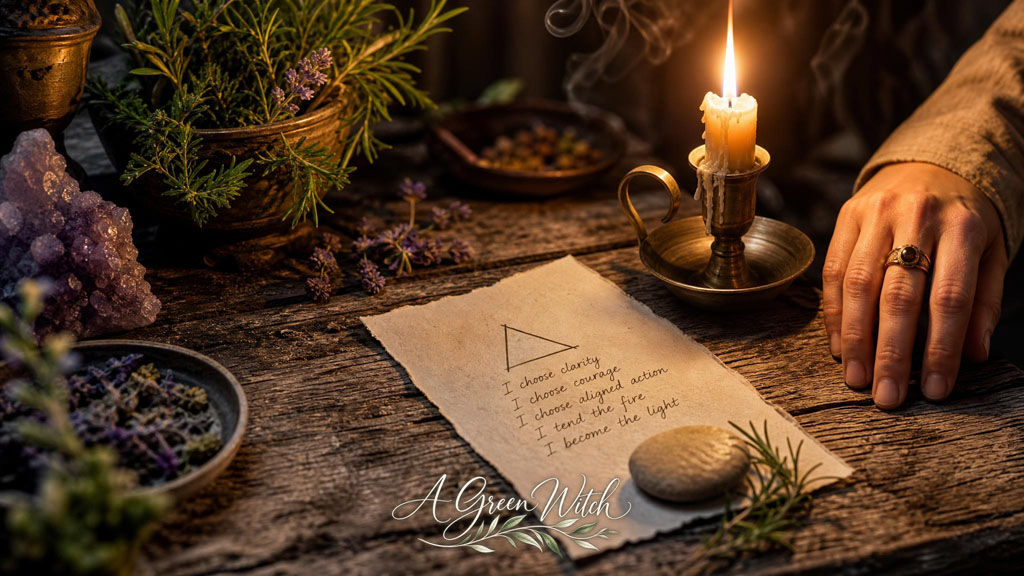
- Draw the Fire triangle on paper and place one clear next step inside it.
- Tend something already in motion: stir the compost, finish a page, make the call or protect an hour for creative work.
The last option is easy to underestimate. Fire is not only represented by what glows. It is present in the act that changes what happens next.
A Simple Fire Practice: From Spark to Step
This is not a spell for instantly becoming fearless. It is a small practice for closing the distance between intention and action.
- Name one ember. Choose a desire, boundary, creative idea or necessary task that still feels alive. Keep it small enough to act on today.
- Choose a Fire symbol. Light a candle safely, switch on an LED light, hold a sun-warmed stone or place your written intention in a patch of sunlight.
- Speak plainly. Say, “I give warmth to what is ready. I take the next honest step.” Change the words if your own are better.
- Act for ten minutes. Write the opening lines, send the message, clear the work surface, make the appointment or state the boundary.
- Close the practice. Extinguish or switch off the light. Record what you did rather than what you hoped to feel.
That final detail matters. Fire can produce a dramatic mood, but the practice becomes transformative when something moves.
If you want a complete ritual that brings all five elements into one circle, follow the dedicated New Moon ritual using Earth, Air, Fire, Water and Spirit rather than trying to make this overview carry an entire ceremony.

Using Candles and Ritual Fire Safely
Fire safety is not separate from spiritual practice. Attention, responsibility and care are part of the ritual.
Before lighting anything:
- Use a stable, heat-resistant holder on a clear surface.
- Keep flame away from curtains, paper, sleeves, dried herbs, hair and hanging plants.
- Keep children and pets at a safe distance.
- Never leave a candle, cauldron, fire pit or smoldering material unattended.
- Extinguish the flame completely before leaving the area or going to sleep.
- Follow local fire rules and burn bans; never assume a spiritual purpose creates an exception.
- Choose a flameless symbol whenever conditions are dry, windy or uncertain.
The U.S. Fire Administration recommends placing candles at least 12 inches from anything that can burn and extinguishing them whenever you leave the room. Its full candle safety guidance is worth reading if flame is part of your regular practice.
Avoid burning loose paper, oils or herbs in a candle flame. Essential oils can be flammable and should not be placed directly on a burning candle. If you do not have the right vessel, ventilation and knowledge for a material, do not burn it. Symbolic release works perfectly well with torn paper placed in recycling, a message written in water on a sun-warmed stone or words erased from a chalkboard.
Fire Through the Seasons
Fire is often paired with summer, but its character changes throughout the year. Following those changes keeps elemental practice responsive to the actual land instead of frozen inside a correspondence chart.
Spring: The First Spark
Spring Fire is ignition. It is the heat mat beneath seedlings, the lengthening light and the sudden urge to begin twelve garden projects before breakfast. Work with it by choosing what deserves fuel. A spark becomes useful when it has somewhere to go.

Summer: Radiance and Restraint
Summer shows Fire at full volume: long light, ripening fruit, sweat, thunder-baked air and soil that may dry faster than expected. Celebrate vitality, pleasure and visibility, but remember that peak Fire also teaches shade, hydration and limits.
For a seasonal practice centered on the Sun without ignoring the garden’s real needs, explore these grounded Green Witch Litha rituals for the summer solstice.
Autumn: Hearth and Discernment
Autumn Fire cooks the harvest and gathers people inward. Its lesson is selection. What will you preserve? What deserves one more effort before winter? What has become dry fuel taking up room?
Release does not have to involve burning. Prune what is truly dead, compost what is safe to compost and finish one lingering obligation. Let the season provide the metaphor and the practical work.

Winter: The Banked Ember
Winter Fire is not gone. It is conserved.
A lamp in an early-dark room, a pot simmering on the stove and one protected creative habit can all become winter Fire practices. This is a quieter power: less blaze, more endurance.
Imbolc is especially suited to this returning flame. The site’s guide to Imbolc, returning light and the first signs of spring carries that seasonal relationship further.
If you live in the Southern Hemisphere or in a climate that does not follow a four-season temperate pattern, begin with what the land is doing where you are. The most honest seasonal correspondence is the one that sends you outside to notice.
Brigid, Hestia and Salamanders: Different Traditions, Not One List
Fire appears in many religious, mythological and magical traditions, but those traditions are not interchangeable.
Brigid is an Irish goddess associated with poetry, healing, smithcraft and enduring flame, later entwined in complex ways with traditions surrounding Saint Brigid. Hestia is the Greek goddess of the hearth and its central place in home and community. Salamanders entered Western occult correspondence as elemental beings of Fire; they are not the ordinary amphibians that need damp habitat and protection from heat.
These figures can deepen a Fire practice when approached with curiosity and respect. Rather than gathering them into one decorative list, take time to learn their distinct stories and traditions. Learn names, stories, cultures and living traditions before invoking anyone. Deity work is also optional. A Green Witch can honor Fire through the hearth, Sun and responsible action without pledging devotion to a god or goddess.
Readers drawn specifically to Brigid can continue with this fuller guide to Brigid’s sacred flame, poetry, healing and earth-centered magic.

Fire for Courage, Creativity, Boundaries and Anger
Fire language is often used for the emotions that make us feel vividly alive. Passion burns. Anger flares. Inspiration sparks. Desire smolders. The metaphors are so familiar that we can forget to ask what each flame is doing.
Courage and Creativity: The Fire That Moves
Courage is not the absence of fear. In Fire practice, it can be the heat that lets you move while fear is still present. Choose the smallest action that proves movement is possible. A brave email counts. So does asking for help.
Creative Fire needs both permission and fuel. Give it raw material: a basket of herbs to sketch, a garden problem to solve, a story you cannot stop thinking about. Then give it a container. An hour is a container. A page is a container. A deadline can be one too.

Boundaries and Anger: The Fire That Protects
A hearth fire warms because it is contained. This makes Fire a useful symbol for boundaries that protect what is tender without punishing everyone nearby. A good boundary tells the truth about what you will do; it is not merely a threat about what someone else must do.
Anger can reveal that something matters, a limit has been crossed or harm needs attention. Calling it sacred does not make every action taken in anger wise. Fire asks for a hearth here too: a place where heat can become clarity, protection, speech or change without consuming the person carrying it.
If anger feels unsafe or overwhelming, step away from flame and seek appropriate support. No spiritual symbolism requires you to remain alone with something dangerous.
Fire Element Journaling Prompts
Use one prompt, not all of them at once. Fire likes focus.
- What is quietly asking for more of my warmth and attention?
- Where am I waiting to feel fearless before I act?
- What am I feeding out of habit that no longer deserves fuel?
- Which boundary would protect my creativity rather than restrict it?
- When does my passion become pressure?
- What does a steady flame look like in my life—not a bonfire, just enough light for the next step?
- What can I transform without destroying?
Affliliate Link

Explore Beautiful Printed Journals →
Frequently Asked Questions About the Fire Element
What does the Fire Element represent in witchcraft?
Fire commonly represents will, action, courage, passion, creativity, protection, purification and transformation. Meanings vary across traditions, and an individual practitioner may build additional correspondences through experience with season, place and practice.
What direction and season correspond with Fire?
Many modern Wiccan and Western magical systems associate Fire with South and summer, often with noon as its time of day. These are traditional correspondences rather than universal laws. Practitioners may adapt them to their climate, hemisphere, lineage or lived landscape.
Do I need a candle to work with Fire?
No. Sunlight, cooking heat, movement, warm color, an LED candle, a solar lantern, a Fire symbol or one deliberate act can all represent Fire. A flame-free practice is the wiser choice whenever open fire is prohibited, unsafe or unwelcome.
What is the elemental symbol for Fire?
Fire is commonly represented by an upward-pointing triangle. It suggests rising flame, aspiration and active movement.
Is Fire always considered masculine?
No. Some traditional correspondence systems call Fire masculine or projective, but not every Witchcraft tradition uses gendered elemental categories. Many contemporary practitioners understand Fire as an active quality available to people of every gender.
How can a beginner start working with Fire?
Start by observing one real form of heat or light. Notice the morning Sun, cook something slowly or sit near a safely contained flame. Then pair that observation with one small action. You do not need a formal initiation, expensive tools or a dramatic ritual.
How do I know if my Fire is out of balance?
In reflective elemental practice, low Fire may resemble avoidance, lack of momentum or difficulty beginning. Excess Fire may resemble impulsiveness, constant urgency, conflict or burnout. These patterns are not medical diagnoses. Use them as questions, not verdicts.
Can I work with Fire during a drought or burn ban?
Yes—without open flame. Choose sunlight, an LED candle, warm colors, cooking indoors with normal safety precautions or an action-based practice. Respecting restrictions is itself a meaningful act of protection and land relationship.

Tend One Honest Flame
The Fire Element does not require you to blaze all the time.
Some days, Fire is a declaration. Some days, it is laughter around a table, a pan warming on the stove or the nerve to say no. In difficult seasons, it may be nothing more dramatic than an ember kept alive beneath the ash.
Look for the warmth that is actually present. Give it a safe boundary. Offer it only the fuel you truly mean to give.
Then let one small thing change.